Aug 24, 2026Product Information
What Kind of Table Lamp Do Interior Designers Actually Buy in Bulk? — Four Traits, One Answer
Designers buy 50+ lamps a year. They don't pick the most striking ones — they pick the ones that "work anywhere." Four traits. One answer. 👇
I know an independent interior designer. She handles over a dozen residential projects a year, and each project needs at least 3 to 5 table lamps. That means she buys over 50 lamps a year for her clients.
I asked her: "What's your selection criteria for table lamps?"
She thought for a moment and said: "The criteria is — it can't 'pop out.'"
That answer summarizes almost everything about how designers buy lamps in bulk.
Trait #1: There Are Many Colors That Look Good — But Only One That Can't Go Wrong
Designers don't buy lamps for themselves. They buy them for their clients' spaces. And a client's home — the sofa might be dark green, the walls might be latte-colored, the rug might have geometric patterns. When the designer picks a lamp, they don't know exactly how all these colors will eventually come together. So they need a color that gets along with everyone.
What colors get along with everyone? Off-white, light gray, linen, cream, charcoal, black. The common thread: they have no attitude. They're not warm or cold, loud or shy. They just sit there quietly and give light.
Among the lamps designers bulk-purchase, colored ones account for less than 5%. That 5% is usually bought for the designer's own use, or for a portfolio cover project. Not for repeat orders.
Trait #2: Good Design Is Design You Don't Notice
There's a phrase that circulates widely among designers: "Good design is invisible design."
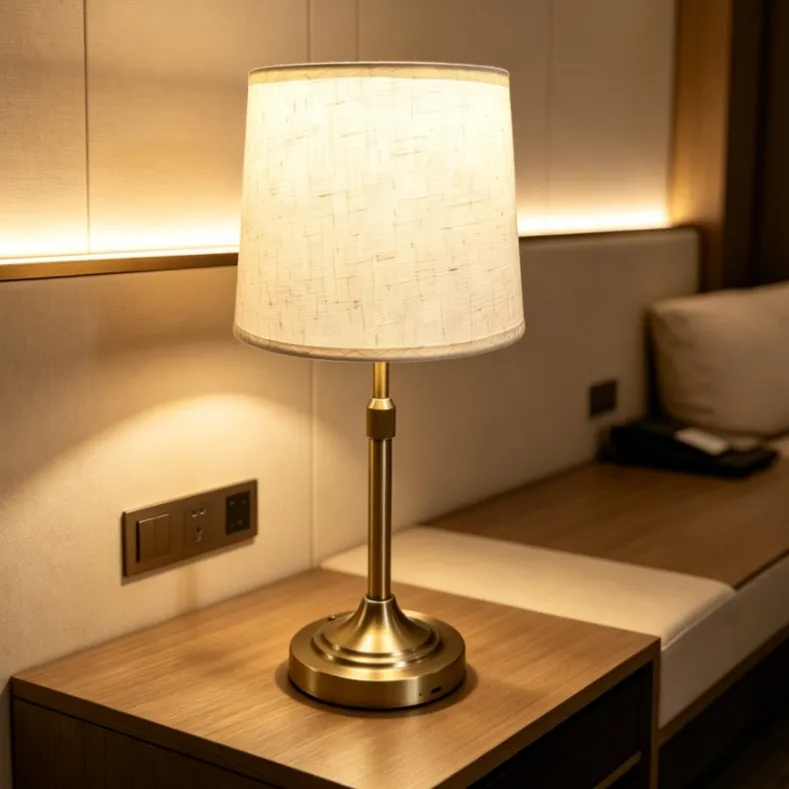
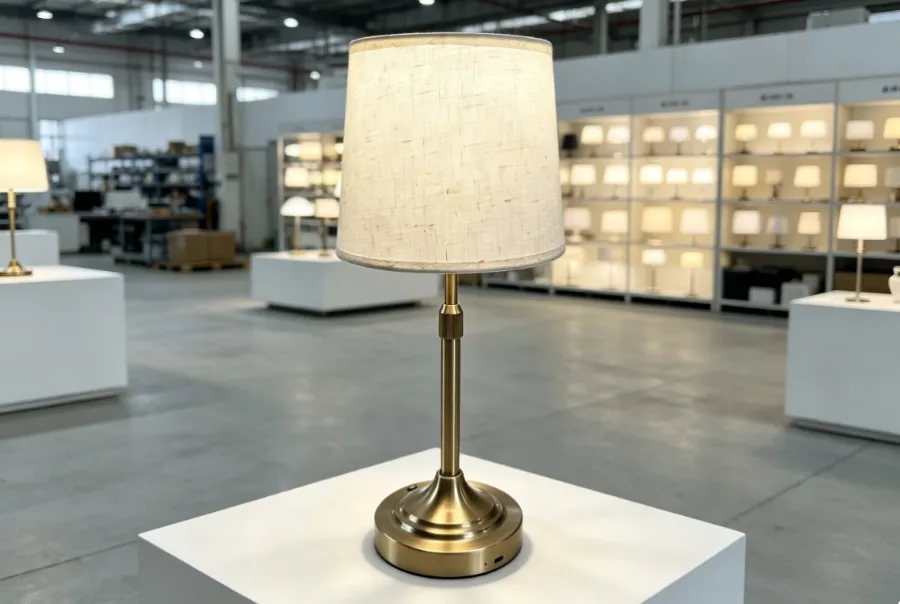
This is especially true for table lamps. The lamps designers buy in bulk have extremely simple silhouettes — a cylinder on a disc, a cone on a cylinder, almost no "extra moves." No complex carvings. No abrupt decorative lines. No traces of "look, I'm trying hard to design."
This kind of "effortless" design is actually the hardest to achieve. Because restraint is harder than excess. Less is harder than more.
A designer doesn't need "stunning." They need "safe." A lamp with too much personality might "fight" with other elements in the space. A lamp that barely exists, ironically, fits everywhere.
Trait #3: A Fabric Shade Isn't a Choice. It's the Standard.
Flip through designers' portfolio photos, and you'll notice a pattern: over 70% of the table lamps have fabric shades — linen, cotton, blends. Soft. Translucent. Textured.
Why fabric? Because a designer isn't selling a lamp. They're selling the feeling of wanting to stay in that space.
Metal shades throw focused, harsh light. Glass shades are transparent and direct. Fabric shades filter the light — softer, warmer, slightly hazy. That kind of light naturally makes people relax, makes them want to sit down.
And fabric itself has tactility — it feels warm to the touch, looks artisanal. In a modern home full of smooth surfaces (marble, glass, lacquer), a fabric shade offers a rare kind of "softness." For designers, it's almost irreplaceable.
Trait #4: Mobility Matters More Than Fixity
Here's an "invisible" trait: more and more of the lamps designers bulk-purchase are rechargeable or battery-powered.
Why? Because designers lay out a space based on human activity, not on where outlets happen to be. A lamp that doesn't need an outlet can go on a bookshelf, a windowsill, the end of a hallway — anywhere light is needed but power isn't available.
This sounds like a small feature. But for designers, it's a feature that liberates their imagination.
Three Suggestions for Manufacturers
First, stick to neutrals. Off-white, light gray, linen, cream — these four colors already cover 80% of what designers need.
Second, do less. The simpler the lamp's form, the better. Don't add any "decorative" elements. You might think you're "doing design." The designer thinks you're "making noise."
Third, prioritize fabric. If you have to choose between "metal + fabric" and "all metal," pick the former. Designers are willing to pay 30% more for that layer of fabric.
Final Thought
A designer's lamp doesn't need to be seen. It needs to be needed. It stands quietly in the corner, illuminating a book, a cup of tea, a quiet evening. It doesn't compete for attention. But it makes the whole space feel more worth staying in.
That's the real reason designers buy it in bulk.
Hashtags
#InteriorDesign #DesignerTips #TableLamp #HomeDecor #FabricLamp #MinimalistDesign #LightingDesign