Jul 24, 2026Industry Information
Quick Guide to Worldwide Plug Standards (With Illustrations)
Article is a clear breakdown of the major plug types worldwide, along with a handy country reference table.
Plug standards may seem trivial, but they're one of the most familiar "international jokes" for travelers. Your charger might very well refuse to fit into the wall socket of your next destination.
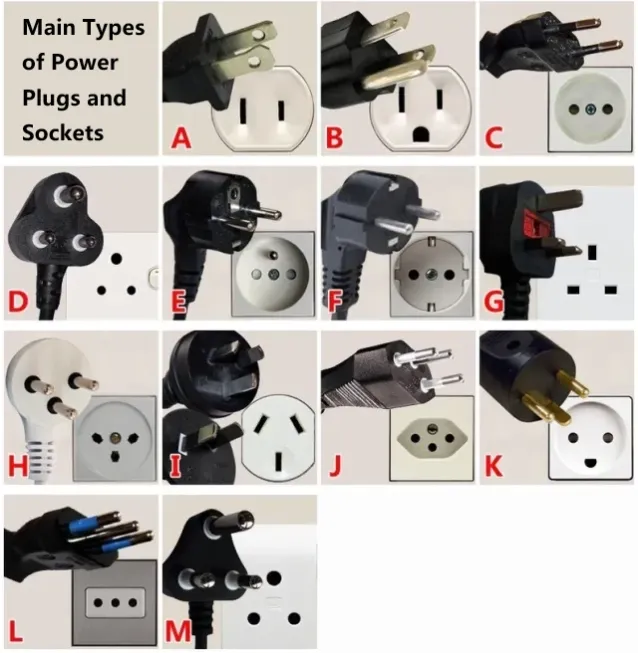
Below is a clear breakdown of the major plug types worldwide, along with a handy country reference table. (Note: The diagrams show standard top‑view outlines; actual prongs are made of metal.)
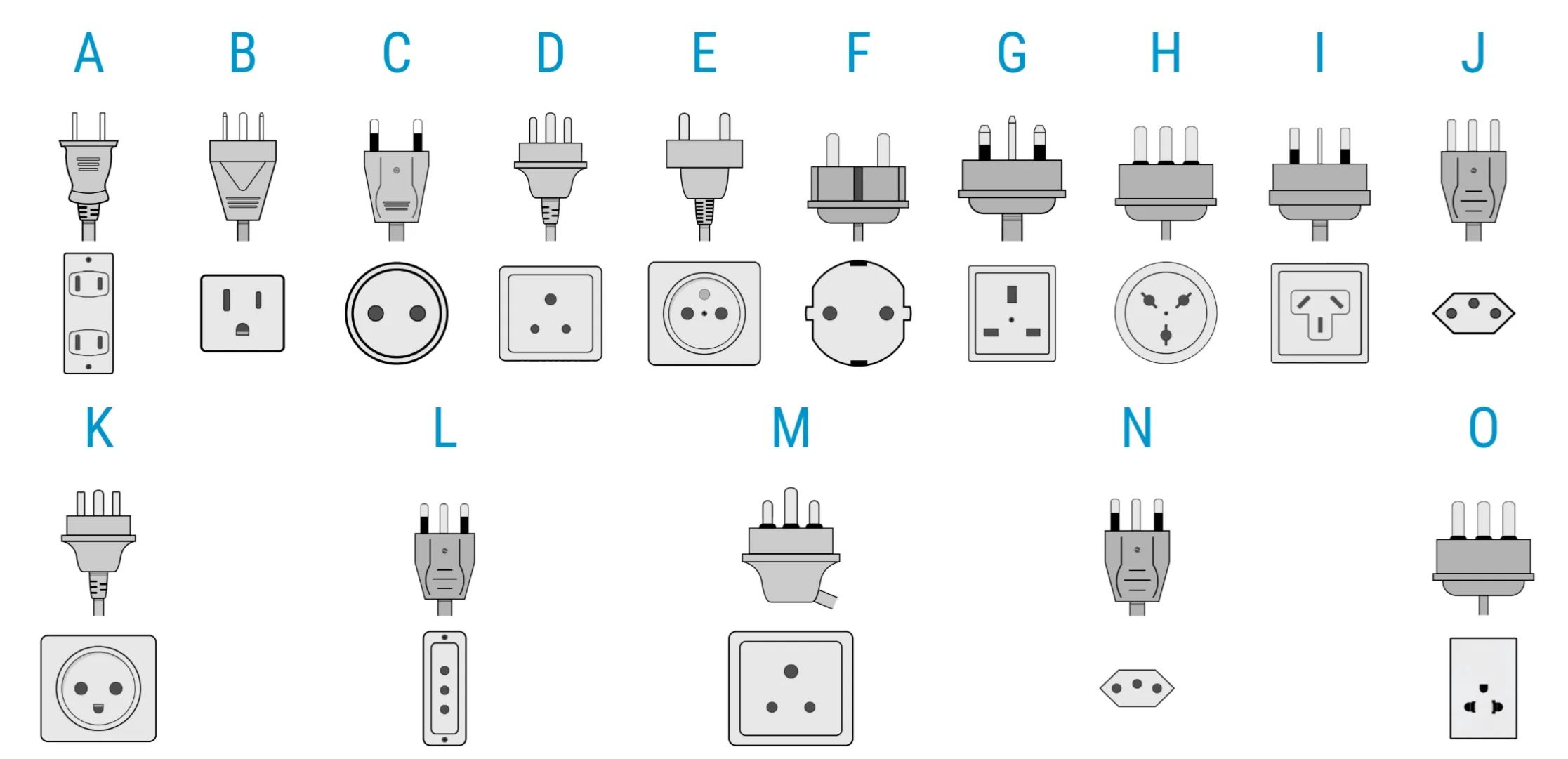
Major Plug Types at a Glance
Type A (US standard) – Two flat prongs, one wider than the other (polarized). No grounding pin.
Used in: United States, Canada, Japan, Mexico. Note: Japan uses a lower voltage (100V) and both prongs are the same width.
Type B (US grounded) – Same as Type A, plus a round grounding pin below.
Used in: United States, Canada, Taiwan (110V).
Type C (Euro 2‑pin) – Two round prongs, 4.0mm in diameter, 19mm apart. No grounding. This is the most basic European plug standard.
Used in: Most of continental Europe (including France, Germany, Spain, Italy, etc.) and parts of South America.
Note: Almost all European countries use Type C (for small, double‑insulated devices without grounding) alongside their own grounded standard.
Type E (French standard) – Two round prongs, but the socket has a protruding grounding pin (the plug has a matching recess).
Used in: France, Belgium, Poland, etc.
Actual use in France: Type C + Type E
Type F (German/Schuko) – Two round prongs with two side grounding clips.
Used in: Germany, Austria, Netherlands, Spain, Portugal, Eastern and Northern Europe.
Actual use in Germany: Type C + Type F
Actual use in Spain: Type C + Type F
Type G (British standard) – Three rectangular prongs in a triangular pattern, built‑in fuse – widely recognized as one of the safest plug designs in the world.
Used in: UK, Ireland, Malaysia, Singapore, Hong Kong, India, Malta.
Type I (Australian standard) – Three flat prongs in a V‑shape (two angled prongs + one vertical grounding pin).
Used in: Australia, New Zealand, China (partial compatibility), Argentina.
Type J (Swiss standard) – Three round prongs in an inverted triangle (offset grounding pin). Incompatible with other standards.
Used in: Switzerland, Liechtenstein.
Type K (Danish standard) – Three round prongs with the grounding pin at the bottom.
Used in: Denmark, Greenland.
Type L (Italian standard) – Three round prongs aligned in a row (or triangle). Two versions (10A and 16A) with different pin spacing.
Used in: Italy, Chile.
Type N (Brazil/South Africa) – Three round prongs in a triangle. Partially compatible with Type C.
Used in: Brazil, South Africa.
Country/Region Reference Table
Country / Region | Plug Types | Voltage | Frequency |
|---|---|---|---|
Mainland China | A (US 2‑pin), I (AU 3‑pin) | 220V | 50Hz |
USA, Canada | A, B | 120V | 60Hz |
UK, Hong Kong | G | 230V | 50Hz |
France | C, E | 230V | 50Hz |
Germany | C, F | 230V | 50Hz |
Spain | C, F | 230V | 50Hz |
Australia, New Zealand | I | 230V | 50Hz |
Japan | A, B (rare) | 100V | 50/60Hz |
Taiwan | A, B | 110V | 60Hz |
Practical Travel Tips
- Check the voltage – A plug adapter does NOT convert voltage. Before you leave, check if your devices support wide voltage (100‑240V). If not (e.g., hair dryers, curling irons), you'll need a separate transformer.
- Universal travel adapters – Opt for one that covers multiple standards (e.g., E/F/G/I prongs) and includes USB‑C fast charging – one gadget covers all your global charging needs.
- Europe travel note – For France, Germany, or Spain, simply bring a "Type C + E/F universal" European adapter. The vast majority of European adapters on the market are compatible with all three types.
- UK is special – For the UK or Hong Kong, you must bring a Type G adapter. Most other plugs simply won't go in.
Final note: The prong outlines above are schematic only. Always double‑check exact dimensions and grounding positions before you travel. And before you leave, confirm the latest standards for your destination – so you never face the "power‑but‑no‑socket" dilemma.